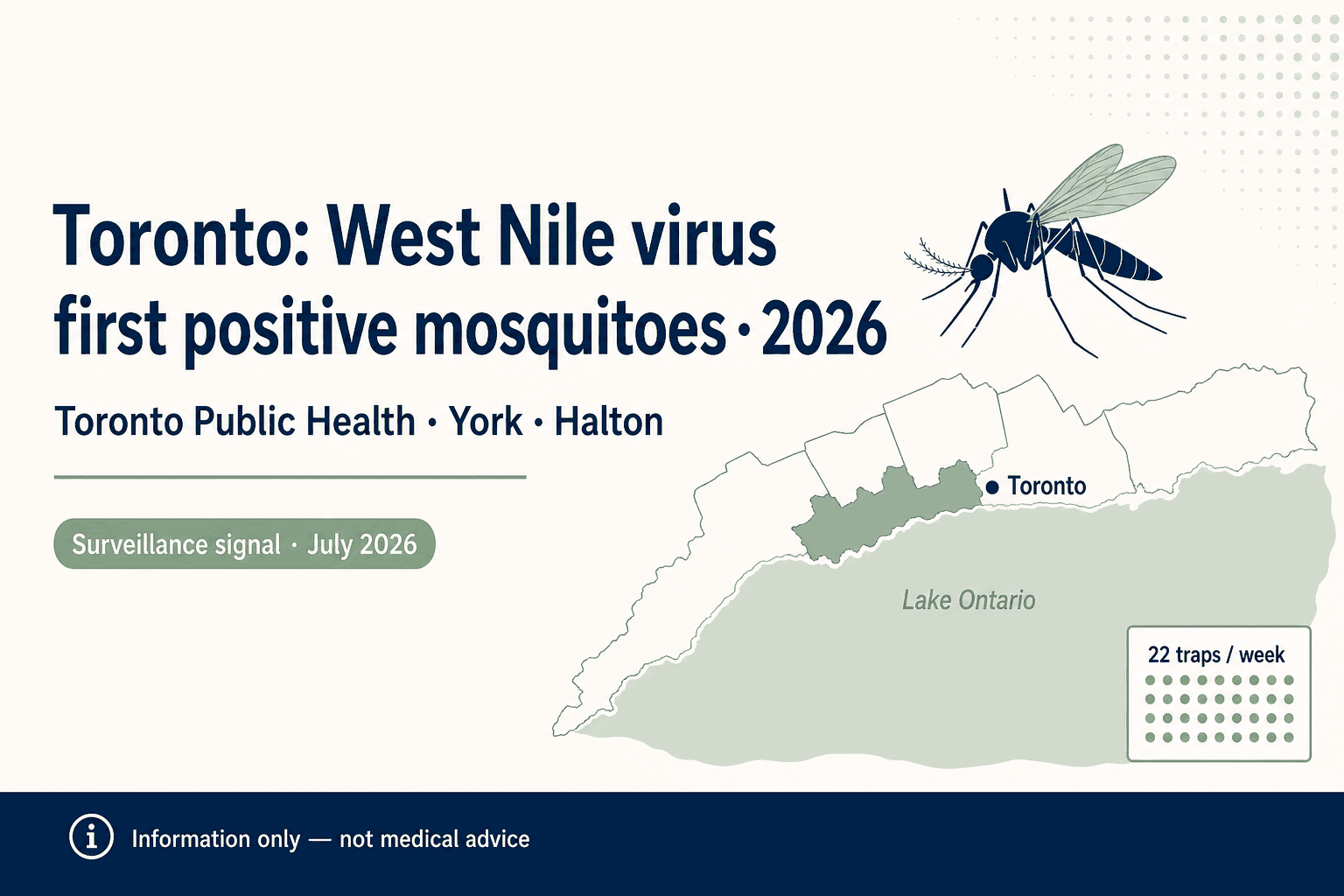
On a humid July evening in Toronto, most people are thinking about patio reservations, not laboratory batch numbers. But public health teams have been running a quieter clock since mid-June: set traps, collect mosquitoes, ship samples, wait for results. On 17 July 2026, that routine produced the headline. Toronto Public Health (TPH) received confirmation that one batch of mosquitoes tested positive for West Nile virus, the first positive finding in the city for the 2026 season. The announcement does not, by itself, mean an outbreak is underway. It means the surveillance system did exactly what it is designed to do: detect virus activity in local mosquito populations before most people feel sick.
What Toronto Public Health confirmed on 17 July 2026
In its 17 July 2026 news release, TPH stated that one batch of mosquitoes tested positive for West Nile virus. These were the first mosquitoes to test positive for the virus in Toronto in 2026. West Nile virus is an infection that can be transmitted to people through the bite of an infected mosquito. TPH emphasized that while the risk of getting infected with West Nile virus in Toronto is low, residents should still take precautions to avoid mosquito bites.
How Toronto’s mosquito surveillance program works
Every year, TPH conducts mosquito surveillance from mid-June until mid-September. Once a week, 22 traps are set across Toronto to collect mosquitoes. The mosquitoes are then submitted to a laboratory for identification and testing. This is an environmental signal, not a human case count. A positive mosquito batch tells officials that virus is circulating in the local mosquito population, which helps guide public messaging and local control efforts. It does not identify which neighbourhood received the positive trap, and TPH’s release does not name a specific trap location.
Regional context: York Region and Halton Region
Toronto’s July 17 announcement arrived one day after York Region Public Health reported its own first positive mosquito traps of the summer. In a 16 July 2026 media release, York Region stated that traps in Markham at Warden Avenue and Highway 7 East and at Kennedy Road and 16th Avenue tested positive. Those were the first positive traps reported in York Region that summer.
Halton Region had already recorded its first positive batch earlier in the season. In a 2 July 2026 media release covering the week of 29 June 2026, Halton reported one batch of trapped mosquitoes tested positive for West Nile virus, the first for Halton in 2026. Halton noted that urban areas are more likely to have mosquitoes that carry West Nile virus, and that the mosquitoes that transmit the virus to humans most commonly breed in standing water around homes, such as bird baths, plant pots, old toys, and tires.
Federal surveillance: how Canada tracks West Nile virus
The Public Health Agency of Canada (PHAC) runs national mosquito-borne disease surveillance using a One Health approach that includes human cases, mosquito pools, horses, and dead wild birds, depending on what each province or territory reports. PHAC’s seasonal dashboard notes that surveillance practices vary by jurisdiction, and that counts on provincial or municipal websites may differ from federal totals because reporting partners update PHAC on different schedules. For the 2026 season, PHAC states that only Manitoba and Ontario are currently providing mosquito pool testing to the federal system. Ontario had already reported positive dead wild birds in 2026 before Toronto’s mosquito announcement.
For historical perspective, PHAC’s 2024 surveillance summary reported 190 human West Nile virus cases nationally, with 177 likely acquired in Canada. Ontario reported 81 of those domestically acquired cases in 2024, the highest provincial count that year alongside Quebec. Past seasons remind us that positive mosquitoes in July are common in southern Ontario surveillance programs, even when most residents never become ill.
What officials recommend for bite prevention
TPH’s 17 July 2026 release lists practical steps residents can take:
- Wear light-coloured clothing, long pants, and long-sleeved shirts when outdoors.
- Apply a Health Canada-approved insect repellent when outdoors, following the manufacturer’s instructions.
- Take extra care during peak mosquito-biting hours (dusk and dawn) by using repellent and covering up.
- Ensure windows and doors have tight-fitting screens and do not have holes.
- Remove standing water from properties so mosquitoes do not have a place to lay eggs. Standing water includes water that collects in pool covers, buckets, planters, toys, and waste containers.
York Region and Halton Region publish similar guidance, including using repellents containing DEET or icaridin where label directions allow, maintaining window screens, and cleaning up standing water around homes. York Region also describes larvicide use in catch basins and stagnant public water sources as part of its 2026 West Nile virus control plan.
Symptoms, timing, and who faces higher risk
According to TPH, symptoms of West Nile virus usually develop between two and 14 days after a person is bitten by an infected mosquito. Symptoms may include fever, headache, nausea, vomiting, body aches, skin rash, and swollen lymph glands. Adults aged 50 and older and individuals with compromised immune systems are at higher risk of severe illness. Halton Region’s materials note that most infected people do not develop symptoms, while a small number may develop severe illness affecting the central nervous system, such as encephalitis or meningitis. Anyone concerned about symptoms should contact a health-care provider.
Research note
Facts in this article were checked against the sources listed below on 18 July 2026. Municipal surveillance pages and PHAC dashboards may be updated after that date. For the latest local guidance, read the current version on the original agency websites.
Frequently asked questions
What did Toronto Public Health confirm on 17 July 2026?
TPH confirmed that one batch of mosquitoes tested positive for West Nile virus. These were the first mosquitoes to test positive in Toronto for the 2026 season, according to the city’s 17 July 2026 news release.
How many mosquito traps does Toronto use each week?
TPH states that during its mid-June through mid-September surveillance season, 22 traps are set across Toronto once per week. Mosquitoes from those traps are sent to a laboratory for identification and testing.
Were West Nile positive mosquitoes found outside Toronto in July 2026?
Yes. York Region Public Health reported its first positive traps of the summer on 16 July 2026 at two Markham locations. Halton Region reported its first positive batch for 2026 during the week of 29 June 2026.
Does a positive mosquito batch mean people in Toronto are getting sick?
Not necessarily. A positive mosquito batch is an environmental surveillance signal. TPH states the risk of infection in Toronto is low, and most people who become infected never develop symptoms. PHAC’s federal dashboard tracks human cases separately from mosquito pool results.
What prevention steps does Toronto Public Health recommend?
TPH recommends covering up with light-coloured long clothing, using Health Canada-approved insect repellent, being extra careful at dusk and dawn, maintaining window and door screens, and removing standing water from properties where mosquitoes can breed.