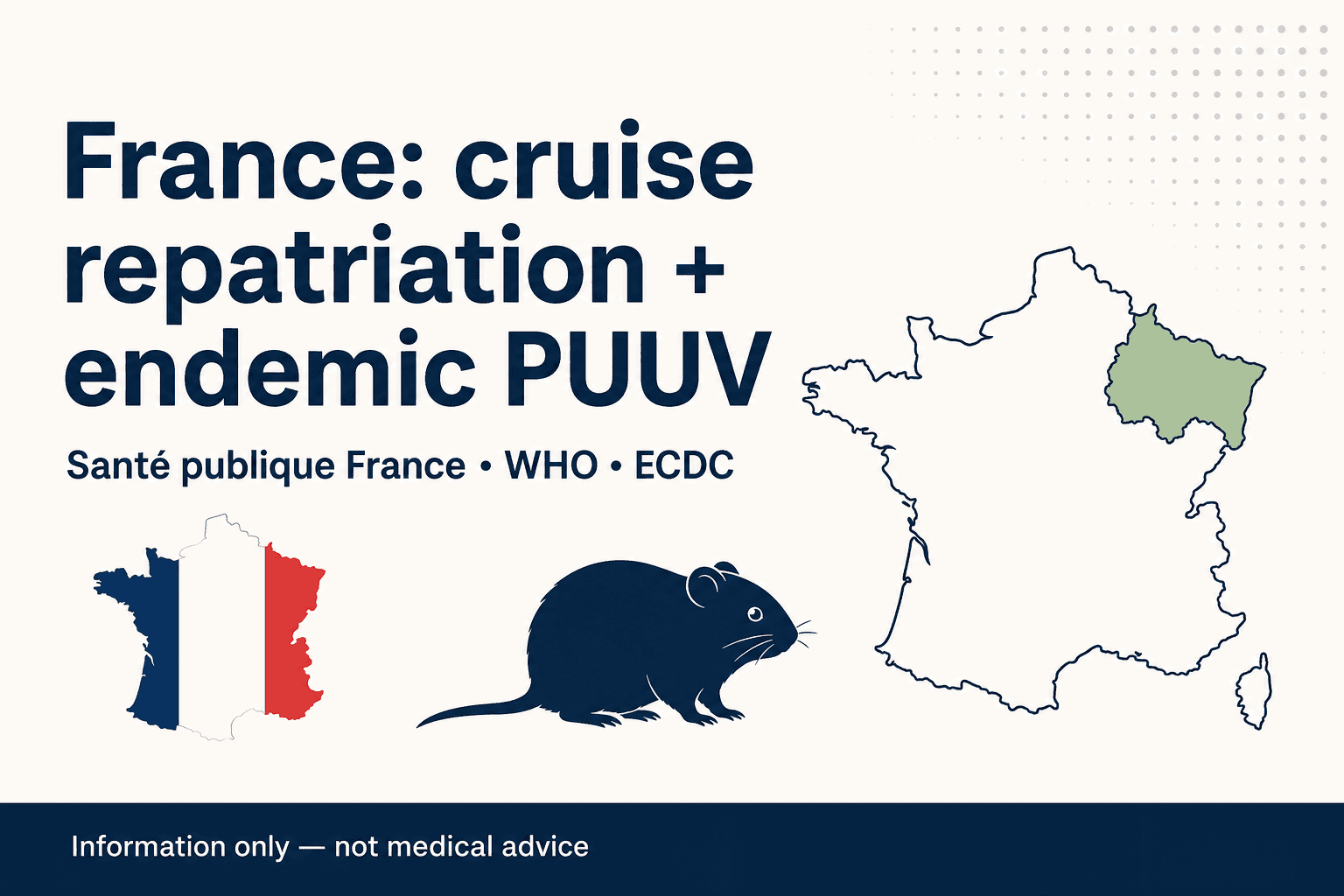
Imagina dos cronologías a la vez. En una, un barco de expedición cruza el Atlántico mientras las agencias publican confirmaciones de laboratorio y planes de repatriación. En otra, el mapa nacional de hantavirus de Francia se actualiza año tras año en el noreste, donde la ecología del ratón de bosque y los patrones de exposición humana importan más que un sello en el pasaporte. Mayo de 2026 forzó el cruce cuando ciudadanos franceses fueron evacuados junto con otros países. El cruce es real, pero la biología no es la misma historia copiada dos veces. Para pensar con claridad necesitas dos titulares internos: qué pasó con viajeros concretos durante un evento multilateral, y qué documenta Francia metropolitana como riesgo endémico rutinario.
Contexto multilateral del barco: qué publicaron la OMS y el ECDC
La Organización Mundial de la Salud (OMS) y el Centro Europeo para la Prevención y el Control de las Enfermedades (ECDC) publicaron actualizaciones operativas sobre el brote de virus Andes vinculado a viaje en crucero en mayo de 2026. Esas páginas son el punto de partida correcto si tu pregunta es identificación en laboratorio, definiciones de caso, calendario de desembarco o cómo las agencias evaluaron el riesgo para el público general. No sustituyen las tablas nacionales de vigilancia de hantavirus de Francia, porque el brote del barco es un evento ligado al viaje con un linaje sudamericano, no un mapa de dónde los roedores franceses vierten Puumala en una cabaña forestal.
Para un resumen cronológico que ya une el lenguaje de la OMS y el ECDC a la fecha de investigación de este sitio, abre Brote de mayo de 2026. Para prevención que sigue importando en entornos con roedores después de los titulares, abre Cómo mantenerse a salvo.
Titulares de repatriación: confirma la redacción en los medios originales
- Medios internacionales que cubrieron el desembarco en Tenerife informaron que cinco ciudadanos franceses fueron evacuados y que líderes políticos señalaron públicamente que un viajero presentó síntomas compatibles con la infección durante el vuelo de regreso, lo que explica por qué protocolos estrictos de seguimiento doméstico entraron en la conversación.
- Artículos explicativos en el mismo periodo describieron un plan de observación clínica inicial seguido de un aislamiento domiciliario prolongado, con recuentos de días que varían ligeramente según el medio. Trata esos detalles operativos como periodismo atribuido a autoridades salvo que tengas los mismos números en un PDF ministerial con URL estable.
¿Por qué importa el límite? Porque las redes mezclan con facilidad “casos en Francia” con “casos ligados a un barco”. Ambas frases pueden ser ciertas con distintos denominadores, definiciones de caso y días. Al compartir, comparte con precisión: la “vigilancia posrepatriación” no es la misma fila de datos que “casos de SHRF detectados por la red del centro nacional de referencia en un año civil”.
Historia endémica en Francia metropolitana: lo que publica Santé publique France
Santé publique France ofrece una página de “Datos” sobre hantavirus en inglés, actualizada el 2 de diciembre de 2025 en el pase de investigación de este sitio. Resume el trabajo del centro nacional de referencia y tendencias de largo plazo. Indica que entre 2005 y 2024 se diagnosticaron 2.046 casos de fiebre hemorrágica con síndrome renal con el lugar de exposición más probable en Francia metropolitana a través del CNR de hantavirus del Institut Pasteur, con un pico en 2021 de 320 casos y un mínimo en 2013 de 14 casos. También explica que la mayoría de los casos en metropolitana encajan con patrones de exposición del noreste, mientras se observa una expansión de la zona endémica del virus Puumala hacia el sur y el oeste en años recientes.
Para 2024, la misma página describe un año interepidémico en Francia metropolitana, con 75 casos humanos de infección por hantavirus frente a un promedio de 108 casos en el periodo 2012 a 2023. Desglosa categorías de confirmación en lenguaje claro: 55 casos confirmados por detección del virus Puumala, un caso del virus Seoul y 21 casos confirmados por serología y muy probablemente causados por Puumala. Los datos sociodemográficos se mantienen en línea con años previos: edad mediana de 46 años y predominio masculino del 84 por ciento, según el resumen de características de los casos en la página.
La geografía es donde la historia de salud pública se vuelve espacialmente intuitiva. Santé publique France indica que el 40 por ciento de los casos de 2024 se detectaron en zonas endémicas tradicionales como Avesnois, Aisne y Ardenas, mientras el resto se notificó en departamentos que ya habían confirmado casos en años anteriores. También señala que una mayoría de diagnósticos de 2024 se concentró en Nord, Aisne, Ardenas, Mosa y Mosela, y cuantifica cuántos departamentos han registrado al menos una infección diagnosticada a lo largo del tiempo a medida que se amplía el área de circulación documentada.
El virus Seoul es una historia de reservorio distinta a la de Puumala ligada a roedores de bosques del norte. Santé publique France indica que se han identificado once infecciones por virus Seoul en Francia metropolitana desde que se introdujo la prueba en 2012, y destaca que el departamento del Ródano notificó su primer caso confirmado de hantavirus en 2024 como infección por virus Seoul, con discusión sobre trabajo ecológico de roedores en el área de Lyon. Si vives lejos del clúster clásico del noreste, ese párrafo te recuerda que “no ver casos históricamente” no es lo mismo que “imposible”.
Cómo leer la próxima ola de titulares sin perder el hilo
Francia seguirá generando dos tipos de menciones de hantavirus: alertas importadas y ligadas a viajes dentro de investigaciones multilaterales, y resultados estables de vigilancia nacional ligados a geografía de exposición y dinámica poblacional de roedores. Ambas caben en un modelo mental serio. Ninguna debe borrar a la otra. El hábito útil del lector es preguntar tres cosas en cada publicación: qué genotipo de virus se nombra, qué sistema de vigilancia del país produjo el numerador y qué fecha estampó la agencia en la web. Si falta alguna respuesta, frena antes de reenviar.
Nota de investigación
Los totales de metropolitana y el desglose de laboratorio se contrastaron con la página de datos en inglés de Santé publique France el 11 de mayo de 2026. El contexto multilateral del barco se alineó con las páginas primarias de la OMS y el ECDC citadas abajo. Las viñetas de noticias resumen la cobertura de mayo de 2026 en lugar de inventar detalles a bordo. Las páginas de agencias y ministerios pueden cambiar tras la publicación, así que lee siempre la fuente en vivo antes de citar cifras en trabajo académico.
Frequently asked questions
¿Francia se convirtió de golpe en un país mayor de virus Andes por el barco?
El brote del barco en mayo de 2026 implicó virus Andes ligado a viaje y rastreo de contactos multilateral. Eso es un linaje y modo de exposición distintos al patrón documentado durante años de fiebre hemorrágica con síndrome renal asociado a Puumala en Francia metropolitana según Santé publique France. Un evento importado puede ser grave sin reescribir todo el mapa endémico nacional.
¿Cuántos casos en Francia metropolitana reportó Santé publique France para 2024?
La página de datos en inglés describe 2024 como un año interepidémico con 75 casos humanos en Francia metropolitana frente a un promedio de 108 casos entre 2012 y 2023, y lista el desglose del CNR con 55 detecciones de Puumala, un caso de virus Seoul y 21 casos confirmados por serología muy probablemente por Puumala.
¿Por dónde empiezo si planeo senderismo en el noreste de Francia?
Empieza por orientación oficial sobre exposición a roedores, ventilación y limpieza segura, y trata el historial regional de casos como motivo de hábitos, no de pánico. La sección de seguridad de este sitio es una entrada práctica, pero debes leer las recomendaciones nacionales vigentes en las páginas ministeriales originales en las que confíes.
¿Por qué los medios mencionan observación hospitalaria y aislamiento domiciliario prolongado?
Cuando figuras públicas describen vigilancia posviaje, a menudo intentan gestionar la incertidumbre durante una investigación en curso, especialmente cuando los periodos de incubación pueden ser largos y los síntomas se solapan con enfermedades más frecuentes. Los recuentos exactos de días deben verificarse en comunicaciones oficiales cuando existan, y cuando solo haya citas periodísticas, cita el medio y la fecha en lugar de tratar los números como ley permanente.